How to Read Your Birth Chart: A Beginner's Guide
Open your birth chart for the first time and it can look like a conspiracy board, symbols and lines crossing a circle in every direction, planets stacked three deep in the same tiny wedge. Here is the part nobody tells you before you get there. There are more than 40 individual placements packed into that wheel, and you can genuinely learn how to read your birth chart in about fifteen minutes, as long as you go in the right order. Your birth chart, also called your natal chart, is a snapshot of exactly where the sky was standing in the first second you took a breath. Learn the order to read it in, and it stops looking like static and starts looking unmistakably like you.
What a Birth Chart Actually Is
A birth chart is a map of the entire sky, frozen at one exact moment, the moment you were born. Every planet, from the Sun to Pluto, gets plotted at the exact zodiac degree it was sitting in that second, then wrapped around a wheel and divided into twelve houses. Nothing about it is symbolic or made up on the spot. It is closer to a time-stamped photograph of the solar system than a horoscope column, which is exactly why it needs real data instead of a birthday alone.
This is also the part that separates a birth chart from your daily horoscope. A horoscope column talks to everyone born under the same Sun sign as if you all live identical lives, because it only has one data point to work with. Your birth chart has closer to forty, ten planets, twelve houses, and dozens of angles between them, all calculated from your specific coordinates in space and time. That is the entire reason two people can share a Sun sign and still feel like they were written by two completely different authors.
That is also why your birth chart asks for three specific things: your date, your time and your place of birth. The date tells the calculation which zodiac sign each planet was passing through. The time and place tell it something more specific, which exact degree of the sky was rising on your personal horizon and which house each planet landed in. Skip the time, and you still get a real, useful chart. Expect the houses and your Rising sign to be exact without it, though, and you are asking your chart to guess at something it was never given the information for.

Step 1. Start With Your Big Three
Every solid birth chart reading starts in the same place, your Sun, Moon and Rising signs together, known as the Big Three. Your Sun is your core identity, the person you are becoming. Your Moon is your emotional inner world, what you need when nobody is watching. Your Rising is your first impression, the version of you that walks into a room before anyone gets to know the rest. Together they are the fastest way to make a chart feel personal instead of generic, and if you have not read up on them yet, our full guide to the Big Three is the natural place to start before going further into the wheel.
What this means for you: If you only remember one rule from this entire guide, remember this order, Sun, then Moon, then Rising, before anything else. It is the fastest route from "a stranger's diagram" to "oh, that is actually me."
Step 2. The Planets: Who's Talking
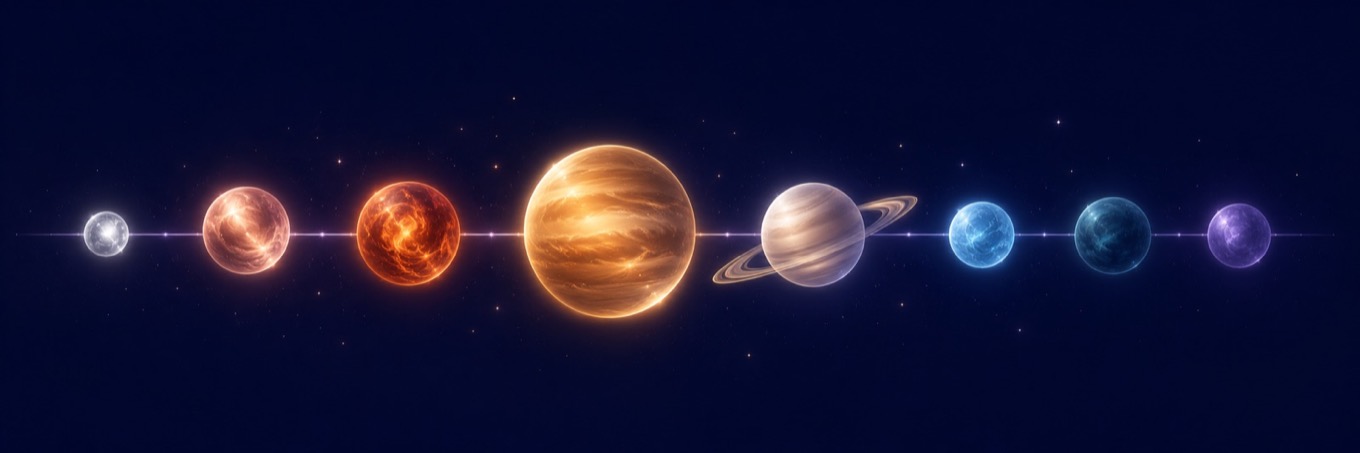
Once your Big Three are locked in, the rest of the chart is really just more planets, each one responsible for a different slice of your life. Astrologers group them into three tiers, based on how personal versus how universal each one is.
The grouping isn't arbitrary. Personal planets orbit fast and finish a full zodiac cycle in under two years, which is why they read as distinctly yours. Social planets take over a decade each to make the same loop. Generational planets can take longer than a human lifetime to complete one full circuit, over 84 years for Uranus alone, which is exactly why they say more about the collective mood of your birth era than about you specifically.
Personal planets (fast-moving, deeply about you)
- Sun: your core identity and the story you are actively writing.
- Moon: your emotional needs and how you self-soothe.
- Mercury: how you think, talk, learn and process information.
- Venus: what you love, value and find beautiful, in people and everything else.
- Mars: how you take action, chase what you want and handle conflict.
Social planets (your growth and your limits)
- Jupiter: where you expand, take risks and find luck or excess.
- Saturn: where you meet responsibility, structure and hard-won mastery.
Generational planets (the whole generation's undertone)
- Uranus: sudden change, rebellion, the urge to break the mold.
- Neptune: dreams, illusions, spirituality and blurred boundaries.
- Pluto: transformation, power and what gets rebuilt from the ground up.
Uranus, Neptune and Pluto move so slowly that everyone born within a few years of you shares the same sign for each, which is why astrologers pay closer attention to the house they land in for you personally than the sign itself. Mercury through Mars, on the other hand, are yours specifically, and worth reading closely.
Step 3. The Signs: How They Talk
If planets are the what of your chart, what part of life is being talked about, signs are the how, the tone and style each planet uses to express itself. The same planet in two different signs can look almost unrecognizable.
Take Mercury, the planet of thinking and communicating. Mercury in Virgo tends to think in checklists, precise, detail-oriented, quietly editing every sentence before it leaves your mouth. Mercury in Pisces tends to think in feelings and images first, translating them into words a beat later, more intuitive than literal. Same planet, same job description, completely different delivery.
Venus tells the same kind of story about how you love. Venus in Taurus wants comfort, steadiness and to be shown love through touch, time and good food, patient and a little possessive in the best way. Venus in Aquarius wants space, independence and love that feels more like friendship than fusion, allergic to anything that feels clingy. Same planet, same department of life, a completely different love language.
Mars follows the same pattern for action and drive. Mars in Aries acts on instinct, fast, direct, impatient for results. Mars in Cancer gets protective first and strategic second, more likely to defend quietly than charge in loudly. Multiply that same idea across all ten planets, and you start to see why a full chart reading feels so much more specific than a single sign ever could.
This is the piece that makes a full chart reading so much richer than a single Sun sign horoscope. Every planet gets its own sign, its own flavor, layered on top of the house it occupies. By the time you have read all ten planets through their signs, you are not reading "a Scorpio" or "a Gemini" anymore, you are reading a genuinely specific combination that is very unlikely to belong to anyone else.
Step 4. The Houses: Where It Happens
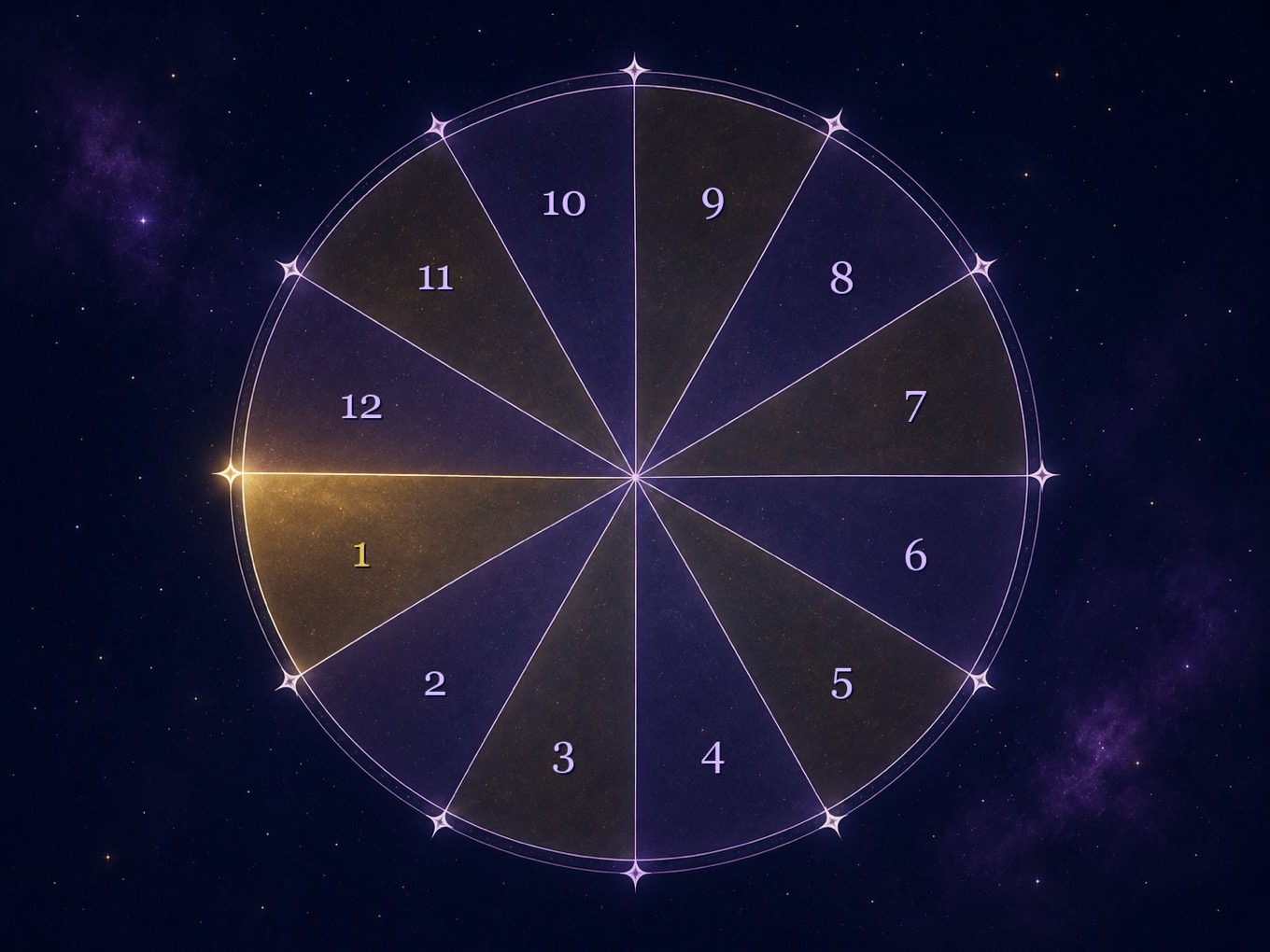
If planets are the what and signs are the how, houses are the where, which area of your actual life each planet's energy plays out in. Your chart wheel is divided into twelve houses, and every one of them governs a different slice of your day-to-day world.
- 1st house: your identity, appearance and how you meet the world.
- 2nd house: money, possessions and what you value.
- 3rd house: communication, siblings and everyday learning.
- 4th house: home, family and your emotional roots.
- 5th house: romance, creativity and self-expression.
- 6th house: work, routines and daily health.
- 7th house: partnerships, marriage and close one-on-one bonds.
- 8th house: intimacy, shared resources and transformation.
- 9th house: travel, higher learning and belief systems.
- 10th house: career, reputation and public life.
- 11th house: friendships, community and long-term hopes.
- 12th house: rest, the subconscious and what stays hidden.
Houses also come in three flavors, angular, succedent and cadent, based on how much initiating energy they carry. Angular houses (1st, 4th, 7th, 10th) tend to feel the most active and outward-facing. Succedent houses (2nd, 5th, 8th, 11th) are about building and stabilizing whatever the angular houses start. Cadent houses (3rd, 6th, 9th, 12th) process, learn and adapt. A stellium sitting in an angular house tends to feel far louder in daily life than the same stellium tucked away in a cadent one.
Two houses carry extra weight, and they're worth knowing by name. The cusp of your 1st house is your Ascendant, the exact degree rising on the horizon at your birth, which doubles as your Rising sign. The cusp of your 10th house is your Midheaven, the highest point of the chart, tied closely to career and public reputation. Together, these two points, called the angles, anchor the entire house wheel around your specific moment of birth.
Houses are also the reason your exact birth time matters so much. They are calculated from the horizon and the meridian at your specific location and minute of birth, which means the entire house wheel can rotate depending on the time you were born, even if every planet's sign stays exactly the same. Get the time wrong by an hour, and a planet that was actually shaping your career (10th house) might get misread as shaping your home life (4th house) instead. This is the single biggest reason a rough birth time is not good enough if you want an accurate house reading.
Step 5. The Aspects: How Planets Talk to Each Other
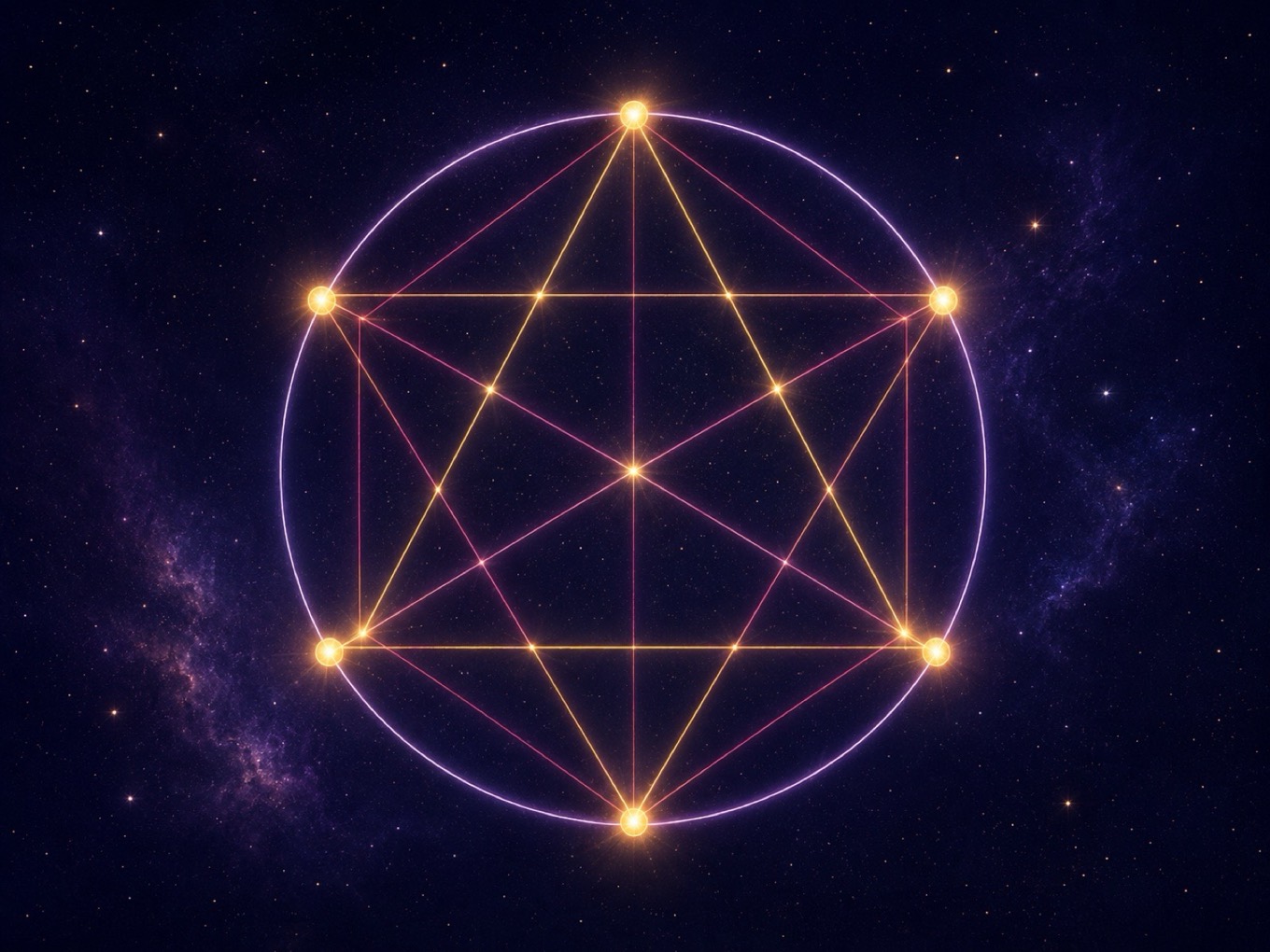
Planets do not sit in their houses and signs in isolation, they form geometric angles with each other across the wheel, called aspects, and those angles describe how two planets' energies work together. Some aspects flow easily. Others create friction that pushes you to grow. Neither is good or bad on its own, they are just different kinds of energy to work with.
- Conjunction (0°): two planets sitting right on top of each other, blending their energies into one intense, combined force.
- Sextile (60°): an easy, supportive connection, opportunity that still takes a little effort to use.
- Square (90°): tension and friction, the kind of internal push-pull that often forces real growth.
- Trine (120°): the smoothest, most naturally flowing connection, talent that comes easily, sometimes too easily.
- Opposition (180°): two planets pulling in opposite directions, asking you to balance and integrate rather than pick a side.
Here's what that looks like with real planets. A Moon square Mars can feel like your emotions and your temper are constantly negotiating, quick to flare, quick to regret it. A Sun trine Jupiter, by contrast, often shows up as natural confidence and good luck that seems to follow you without much visible effort. Same five aspect types, endless different combinations depending on which two planets are actually involved.
What this means for you: A chart full of trines and sextiles can feel easy but sometimes under-motivated, while a chart with more squares and oppositions can feel harder but often builds the most resilience over time. Neither pattern is a life sentence, it is just weather, not climate.
Putting It All Together
So here's the order that actually works for a beginner, the one that turns forty-plus placements into a story instead of a wall of symbols. This is the same open loop we promised in the very first paragraph, and here's how you close it.
- Read your Big Three first (Sun, Moon, Rising) to get the emotional headline of the whole chart.
- Scan for a stellium, three or more planets bunched into the same sign or house, which usually points to a dominant life theme.
- Check your chart's dominant element (fire, earth, air or water) to understand your overall energy and pace.
- Pick one or two aspects to your personal planets (Sun, Moon, Mercury, Venus, Mars) and read those closely, they usually explain your most repeated patterns.
- Layer in the rest, planet by planet, sign by sign, house by house, once the headline actually makes sense.
Most beginners try to read a chart top to bottom, planet by planet, in whatever order it happens to print out, and give up somewhere around the 6th house. Reading order beats reading speed every single time. Start with a random Saturn-Pluto square in your 8th house before you have even met your own Sun sign, and the chart feels like a stranger's homework. Start with your Big Three, and every detail after that has somewhere to attach itself. Fifteen minutes, one wheel, and a version of astrology that is finally about the specific, contradictory, actual you.
Frequently Asked Questions
Can I read my chart without knowing my birth time?
Yes, but with limits. Your Sun sign only needs your birth date, and most planet signs stay stable within a day, so those hold up fine without an exact time. Your houses and your Rising sign are the two pieces that truly depend on an accurate time, since both shift every couple of hours. Without a time, treat your planets and signs as reliable and your houses as a rough guess.
What's the difference between a birth chart and a natal chart?
Nothing, they are the same thing under two different names. "Natal chart" is the more technical astrology term, while "birth chart" is the everyday version most people search for. Both describe the exact same snapshot of the sky at your moment of birth, plotted into the same twelve-house wheel.
What is a stellium?
A stellium is a cluster of three or more planets sitting in the same zodiac sign or the same house. It concentrates a huge amount of your chart's energy into one theme, so whatever that sign or house represents tends to show up as a dominant, unmistakable pattern across your whole life, not just a side note.
Which planet matters most in my chart?
There is no single planet that outranks the rest, but your Sun, Moon and Rising do the most visible day-to-day work, which is why they are the natural starting point. After that, whichever planet sits at the center of a stellium or forms the most aspects to other planets usually ends up feeling like the loudest voice in your specific chart.
How accurate does my birth time need to be?
For your Sun sign and most planet signs, being off by a few hours rarely changes anything. For your Rising sign and your houses, accuracy matters a lot more, since the Ascendant can shift roughly every two hours and house cusps move continuously throughout the day. If your birth certificate lists a time, use it exactly. If you only have a rough estimate, treat your house placements as directional rather than exact.
Ready to See Your Own Chart?
Forty-plus placements sounds like a lot until you have an order to read them in, Big Three first, planets next, then signs, houses and aspects layered on top. You already have everything you need to start making sense of your own wheel. Curious what yours actually says once someone walks you through it properly? Get your full natal chart calculated and explained in the Soulra app, and see how your birth chart compares with someone else's in our compatibility hub, or check what's happening in the sky for you today over on your horoscope.
This article is for entertainment and self-reflection purposes only and isn't a substitute for professional advice.
Go deeper in the app
Your chart, daily readings and a chat with Ra, your personal astrologer.
Download on App StoreSoon